
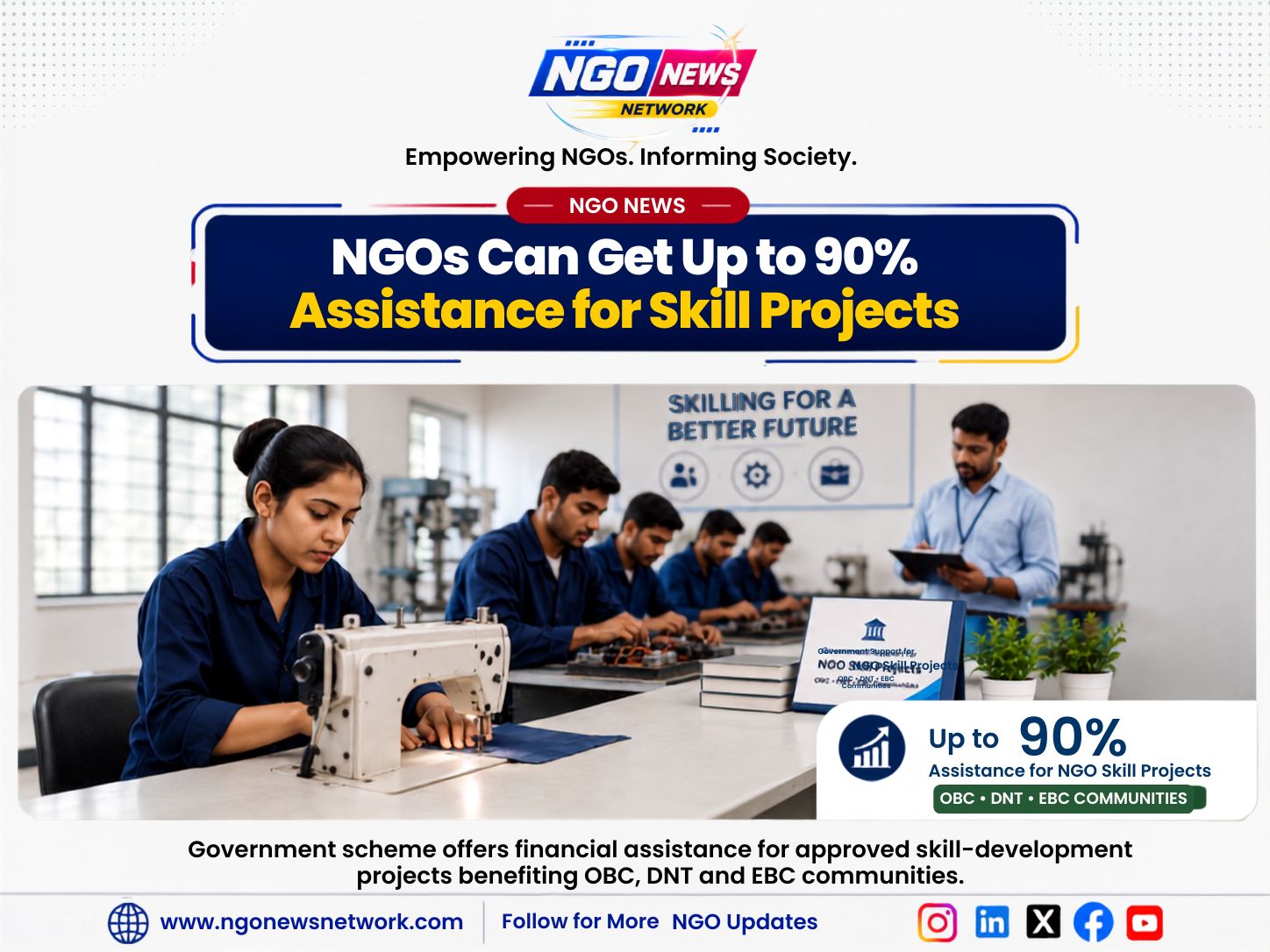
New Delhi, August 11, 2026: NGOs working on skill development and livelihood programmes for Other Backward Classes (OBCs), De-notified Tribes (DNTs) and Economically Backward Classes (EBCs) may have a significant government funding opportunity under the Centre’s Assistance for Skill Development scheme.
The Department of Social Justice and Empowerment’s current scheme information, updated on August 10, 2026, states that eligible NGOs can receive assistance of up to 90% of the approved project cost for new projects, while assistance of up to 75% is available for NGOs that have previously received funding under the scheme.
The scheme is implemented through the National Backward Classes Finance & Development Corporation (NBCFDC) and is aimed at supporting skill-development activities for eligible beneficiaries from OBC, DNT and EBC communities.
What does the 90% assistance mean?
The 90% figure does not mean that every NGO will automatically receive 90% of whatever amount it proposes.
Government assistance is linked to the approved project cost and is subject to the scheme’s eligibility conditions, scrutiny and sanction.
For example, if a ₹10 lakh project is approved at the full proposed cost, the 90% assistance structure would work out to ₹9 lakh in government assistance and ₹1 lakh from the NGO, subject to applicable rules.
This makes the scheme particularly relevant for NGOs that have the community reach and capacity to run employment-oriented skill programmes but face difficulty raising the full project cost themselves.
Which NGOs could benefit?
The opportunity may be particularly relevant to organisations already working with:
- OBC, DNT and EBC communities
- Rural and underserved populations
- Vocational and technical training
- Employment and livelihood development
- Entrepreneurship and income-generation programmes
However, being a registered NGO by itself does not guarantee eligibility or funding.
The government information sets out specific eligibility and application conditions, including different provisions for new and previously funded NGOs. NGOs should therefore verify the current requirements before preparing a proposal.
Location and project planning matter
The current government information also refers to projects located in Sansad Adarsh Gram Yojana villages in the context of NGO eligibility.
For NGOs considering an application, the proposed project’s location, target beneficiaries, training model and organisational credentials should therefore be carefully checked against the applicable guidelines.
A strong proposal should also clearly explain what skills will be provided, how beneficiaries will be selected, who will conduct the training and what employment or livelihood opportunities will follow after training.
How can NGOs apply?
The current government information directs new NGO applications through NBCFDC.
Organisations considering the scheme should keep their basic statutory and financial documentation ready, including relevant registration details, PAN and audited financial records, along with the documents required under the applicable scheme guidelines.
NGOs should also verify the latest application procedure directly with NBCFDC before submitting a proposal, as approval is subject to the government’s assessment and sanction process.
Why this matters for NGOs
For NGOs already working in skill development and livelihood programmes, the assistance structure could reduce the amount of funding they need to mobilise themselves.
The opportunity is particularly relevant for organisations that can demonstrate genuine community reach, a clear training requirement and a credible pathway from training to employment or sustainable livelihood.
At the same time, NGOs should not treat the 90% figure as an automatic grant commitment. Only projects that meet the applicable conditions and receive approval can benefit from the assistance.
The development is therefore best viewed as an opportunity for eligible NGOs to explore government-supported skill-development projects rather than as a blanket funding announcement for all NGOs.
Source: Department of Social Justice and Empowerment, Government of India. The ministry’s current scheme information was marked as updated on August 10, 2026.

Krishna Murari Singh is a contributor and author at NGO News Network, covering developments across the NGO and social sector. His work focuses on NGOs, CSR initiatives, government schemes, social development, community programmes, and important updates relevant to nonprofit organisations and social-impact stakeholders.