Keonjhar, Odisha: In a remote village of Odisha’s Keonjhar district, a farmer’s determination to overcome chronic water shortages turned into an extraordinary community story.
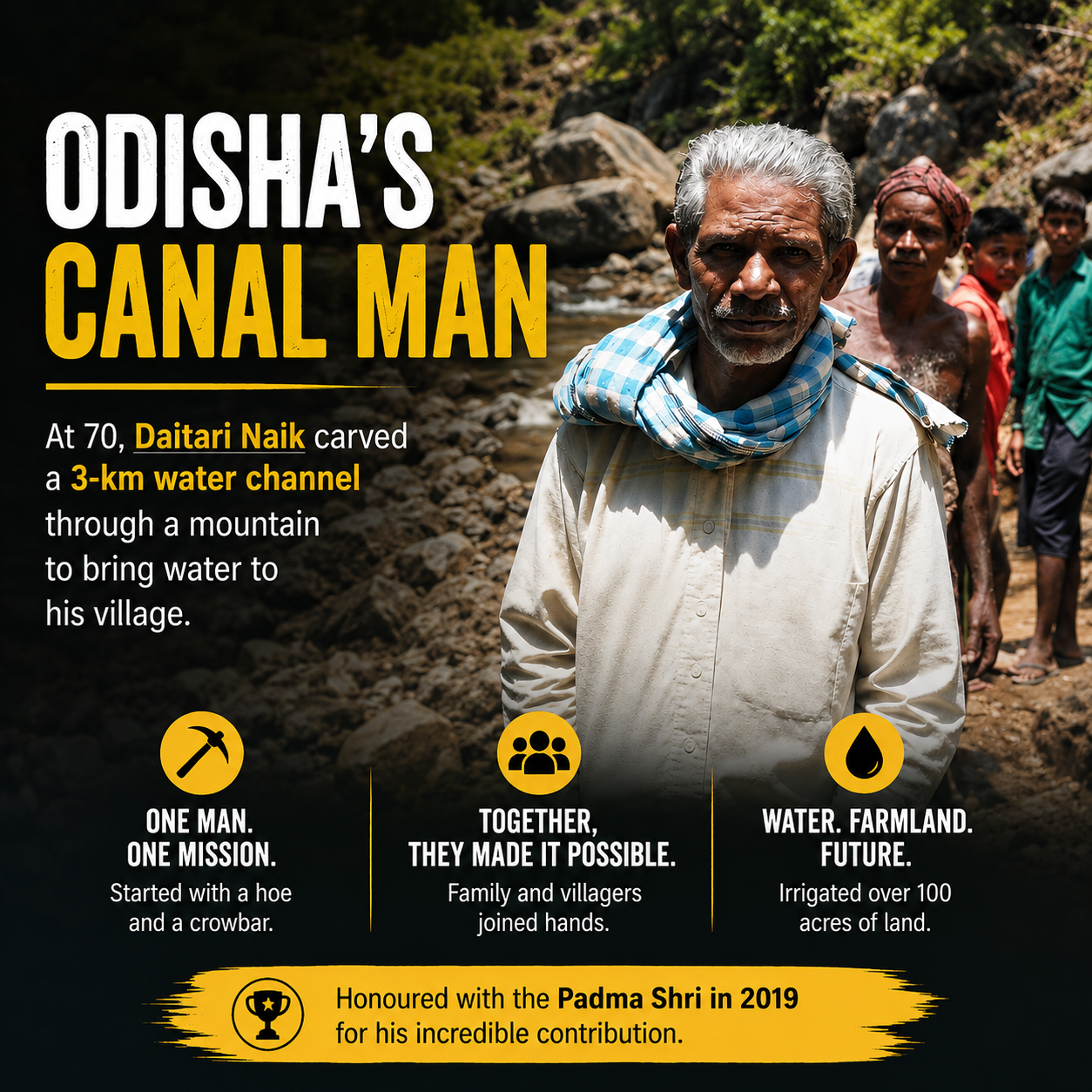
Daitari Naik, a farmer from Talabaitarani village in Banspal block, became known as the “Canal Man of Odisha” after carving a nearly three-kilometre water channel through the Gonasika mountain range to bring water to agricultural land in his village.
The project was undertaken with basic tools and years of physical labour, eventually allowing water from the Karatakata Nullah of the Gupta Ganga to reach the village and support cultivation across around 100 acres of farmland.
A Village Struggling for Water
Talabaitarani had long faced difficulties with water availability. Farming depended heavily on rainfall, leaving agricultural fields vulnerable when the rains were inadequate or irregular.
For families dependent on agriculture and forest-based livelihoods, the lack of reliable irrigation affected both crop production and household incomes.
It was against this backdrop that Naik decided to attempt something that many considered impractical: cutting a channel through the surrounding rocky mountains and diverting water from a nearby mountain stream towards the village.
Armed With Simple Tools
Naik did not have heavy machinery or sophisticated equipment for the task. Reports describe him working with basic implements, including a hoe and crowbar or digging bar, as he gradually cut through the rocky terrain.
His effort initially attracted disbelief from people around him. But he continued working on the project, eventually receiving help from members of his family and other villagers.
According to reporting by The New Indian Express, three of his brothers and two nephews joined the effort. As the project progressed, community participation also increased.
The exact timeline of the work varies across published accounts. Some reports describe the canal as the result of about four years of sustained labour, while other later reporting gives a significantly longer timeline, saying Naik began his effort in the 1990s. What remains consistent across the accounts is that the canal was created through prolonged manual labour and eventually brought water to farmland that had struggled with irrigation.
A 3-Kilometre Canal Changes Farming
The completed channel brought water from the mountain stream towards Talabaitarani and enabled irrigation of approximately 100 acres of agricultural land.
The impact extended beyond water availability. Later reporting from the village found farmers cultivating vegetables, pulses, millet and tubers on land that had previously been difficult to farm outside the rainy season.
VillageSquare reported that the canal helped farmers cultivate throughout the year and reduced the need for residents to leave the village in search of work during dry periods.
For a community whose agriculture had been heavily dependent on rainfall, the canal represented more than an engineering achievement. It became a locally driven response to a basic development challenge: access to water.
Recognition Came Later
Naik’s work eventually attracted attention well beyond Keonjhar.
In 2019, he was awarded the Padma Shri, one of India’s highest civilian honours, in the field of Social Work. President Ram Nath Kovind presented the award to Naik, with the official description highlighting his creation of the three-kilometre canal through the Gonasika mountains and its contribution to irrigating about 100 acres.
Prime Minister Narendra Modi also highlighted Naik’s work during his Mann Ki Baat programme in February 2019, referring to him as the “Canal Man of Odisha” and praising his determination to solve the village’s irrigation problem through his own labour.
Beyond One Man’s Effort
While Naik became the face of the project, accounts of the canal also underline the role of family and community participation.
What began as an individual effort eventually drew support from relatives and villagers. The story therefore became not simply about one farmer cutting through a mountain, but about how a community came together around a locally identified problem.
Today, Daitari Naik’s story is often cited as an example of grassroots problem-solving, community participation and rural resilience.
His achievement also highlights a broader lesson for rural development: when communities have ownership over local challenges and solutions, even limited resources can sometimes be used to create lasting change.

Preeti is a contributor and author at NGO News Network, covering developments across the NGO and social sector. Her work focuses on NGOs, CSR initiatives, government schemes, social development, community programmes, and important updates relevant to nonprofit organisations and social-impact stakeholders.